
Arcade Cabinet
Pac-Man
Year: 1980, Publisher: Namco, Genre: Maze
Pac-Man is a 1980 maze arcade game developed by Namco and originally released in Japan as Puck Man. It became one of the most important and commercially successful arcade games ever made, helping shift arcade gaming away from space shooters and toward character-based action. The idea is simple but brilliant: guide Pac-Man through a maze, eat every dot, and stay away from four ghosts. That clear design, combined with a memorable main character, helped make the game a symbol of arcade culture in the 1980s. Pac-Man was released in Japan in 1980 and then licensed to Midway for North America later that year. Its worldwide success turned Pac-Man into Namco’s best-known mascot and one of the most recognizable figures in video game history.
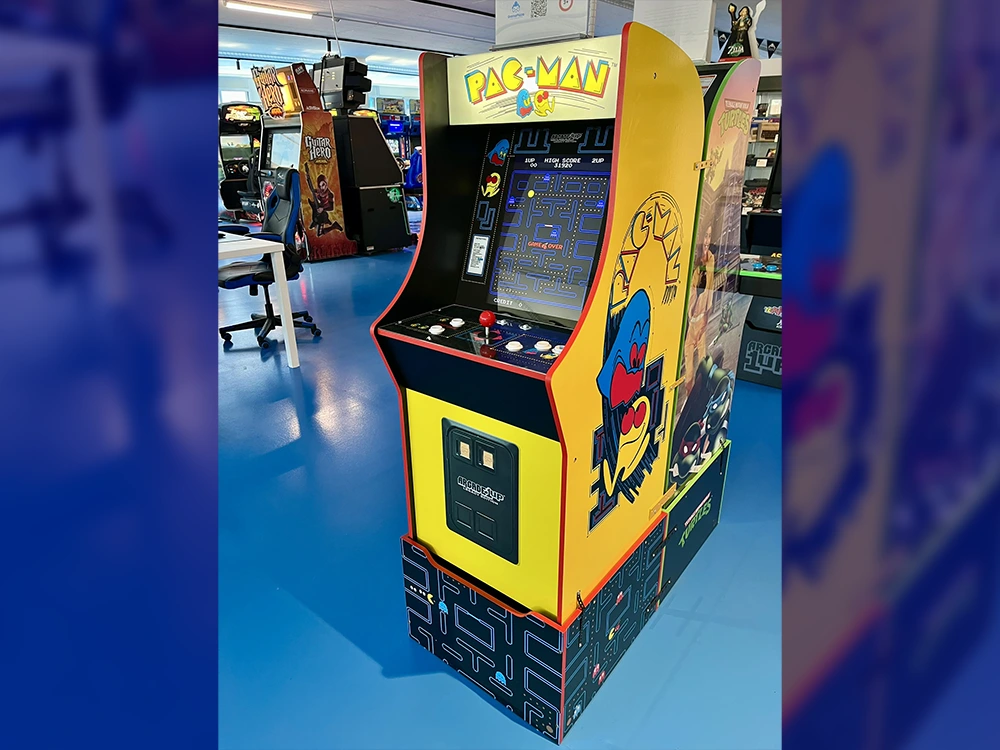
Gameplay and features
Pac-Man is built around maze navigation, survival, and score chasing. Players move through the maze eating dots while trying to avoid Blinky, Pinky, Inky, and Clyde, each of which behaves differently.
Key features include:
- Maze-based arcade gameplay
- Four ghosts with different movement patterns
- Power Pellets that temporarily turn the tables on enemies
- Bonus fruit that appears during rounds
- Warp tunnels on both sides of the maze
- Intermission scenes between certain stages
The game becomes harder as you progress because the ghosts move faster and the Power Pellet effect lasts for less time. That change makes later play much more dependent on route memory and precision.
How to Play Pac-Man
Pac-Man is very easy to understand, even for first-time players. Your goal is to clear the maze by eating every dot without getting caught by the ghosts.
Here is how it works:
- You move Pac-Man through the maze
- Eat all dots to complete the stage
- Avoid the four ghosts
- Eat a Power Pellet to make the ghosts vulnerable for a short time
- Grab bonus fruit for extra points when it appears
Tip: Do not waste Power Pellets too early if the ghosts are not in a good position to be eaten.
Controls and Arcade Machine Guide
Pac-Man uses one of the simplest arcade control setups ever made. That simplicity is part of why the game became so widely popular.
- Joystick controls movement
- Start button begins the game
There are no attack buttons, jumps, or special moves. Everything depends on movement, route choice, and your ability to stay one step ahead of the ghosts.
Tip: Quick changes in direction can help shake ghosts and create space, especially near corners and tunnels.
First Time Playing
If this is your first time playing:
- Focus on learning the maze layout
- Use tunnels when the ghosts get too close
- Do not chase ghosts unless a Power Pellet is active
- Try to clear dangerous corners early
- Stay calm and think a few moves ahead
The game feels simple at first, but the ghost behavior makes every round more interesting than it first appears. After a few games, you start to understand that pattern reading matters just as much as reflexes.
Why Pac-Man Was Special
Pac-Man was special because it gave arcades a new kind of hit. Instead of spaceships, guns, or sports themes, it offered a colorful character, a clear goal, and gameplay that appealed to a much broader audience.
It stood out because of:
- Its strong character design
- Its simple but deep gameplay
- Its broad appeal beyond the usual arcade audience
- Its ghost personalities and movement patterns
- Its massive cultural and commercial success
It also helped prove that a video game character could become a true pop culture icon. That idea would shape the future of gaming for decades.
Pac-Man as a Museum Piece
Pac-Man is one of the most essential museum titles in video game history. It represents a major turning point in arcade design, where personality, visual identity, and approachable gameplay became just as important as challenge.
The game also shows how much could be achieved with very simple controls and a single screen. Its lasting popularity proves that a strong idea and memorable design can matter more than technical complexity.
In a museum setting, Pac-Man is not just a classic game. It is a symbol of the arcade era itself and one of the clearest examples of how games became part of mainstream culture.
Secrets in Pac-Man
Pac-Man has several famous hidden details and advanced-play secrets.
👻 The ghosts do not all think the same way
Each ghost has its own pursuit style, which is why experienced players can learn reliable patterns.
⚡ Power Pellets become less powerful later
As stages increase, the blue vulnerable state lasts for less time and eventually disappears.
💀 Level 256 has the famous kill screen
A programming limitation corrupts part of the screen and makes normal completion effectively impossible on original hardware.
🏆 A perfect score is possible
The maximum score in the original arcade game is 3,333,360 points.
🧠 The real secret is route memory
High-level Pac-Man is not just about quick reactions, because it depends heavily on knowing patterns, timing, and safe paths through the maze.
Play Pac-Man in GamePlaza Video Game Museum, Altstetten, Zurich
You can experience Pac-Man at GamePlaza Video Game Museum in Altstetten, Zurich. GamePlaza is an interactive video game museum where visitors can play original machines and explore gaming history directly. That makes it a perfect place to enjoy one of the most famous arcade games ever created. If you love classic arcade games, gaming history, or simple designs with lasting depth, Pac-Man is an essential game to try. Few arcade titles remain this recognizable so many decades later.
Who Will Love This Game
Pac-Man is perfect for:
- Fans of classic arcade games
- Retro gaming enthusiasts
- Visitors interested in video game history
- Families looking for accessible gameplay
- Anyone curious about one of gaming’s most famous characters
Its controls are simple enough for anyone to learn in seconds, but its scoring depth and ghost behavior make it rewarding even for experienced players.
Ready to Play
Enter the maze and experience Pac-Man for yourself. Visit GamePlaza Video Game Museum in Altstetten, Zurich and discover why this Namco classic remains one of the most iconic arcade games of all time.
Important Info
| Developer(s): | Namco |
| Publisher(s): | JP/DE: Namco NA/FRA: Midway |
| Designer(s): | Toru Iwatani |
| Programmer(s): | Shigeo Funaki, Shigeichi Ishimura |
| Artist(s): | Hiroshi Ono |
| Composer(s): | Shigeichi Ishimura, Toshio Kai |
| Series: | Pac-Man |
| Platform(s): | Arcade |
| Release: | JP: July 1980 WW: December 1980 |
| Genre(s): | Maze |
| Mode(s): | 1-2 players alternating turns |