
Game Console
Xbox One
The Xbox One is a home video game console developed by Microsoft and released in 2013 as the successor to the Xbox 360. It belongs to the eighth generation of home consoles and competed mainly with the PlayStation 4 and Nintendo Wii U, and later with the Nintendo Switch. The system became an important part of Microsoft’s long-term gaming strategy by combining traditional console gaming with digital services, online infrastructure, and broader media integration.
The console is important because it marked a major transition period for Xbox. It moved the platform further toward a digital ecosystem built around downloadable games, online accounts, multimedia functions, and subscription-based services. Even though it faced strong competition, the Xbox One still became one of the major gaming platforms of its generation.
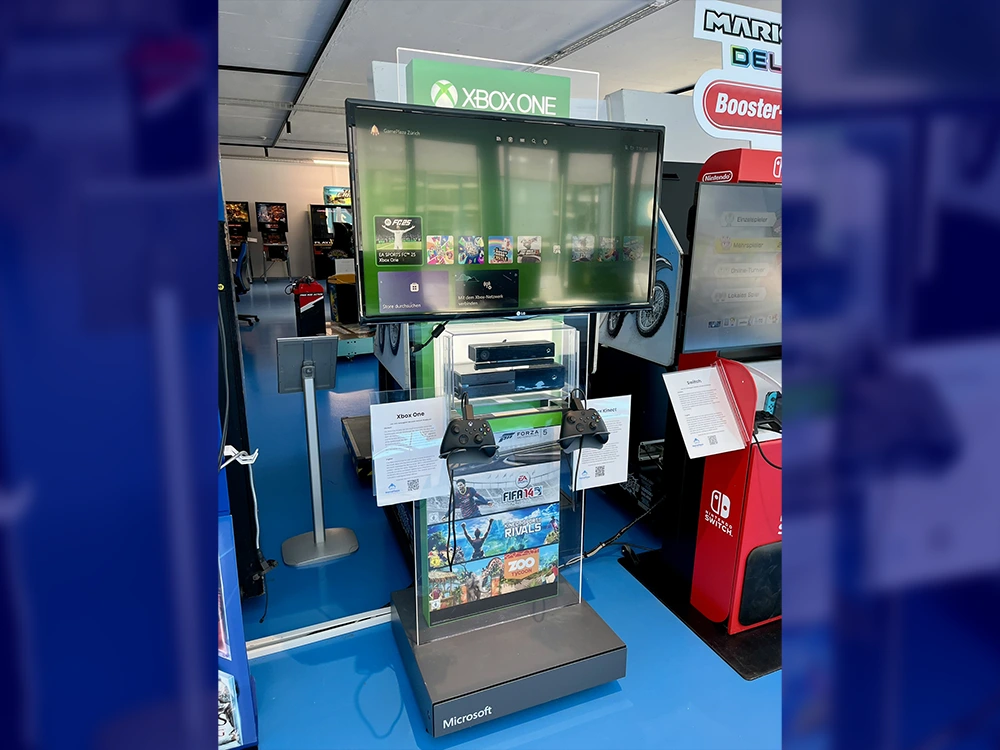
How to Choose and Change Games
GamePlaza Note: To change game, press the “Xbox logo” button in the center of the controller to return to the menu. Use “A” button to select a new game.
The Xbox One supports both physical and digital games. Players can insert a game disc into the console or launch an installed digital title from the home screen or library. This gives users flexibility between collecting boxed software and building a downloadable account-based collection.
To change games, disc-based titles can be switched by ejecting the current disc and inserting another one, while digital games can be changed directly from the dashboard. Many titles also install data onto the hard drive, which helps with loading, updates, and storage management.
- Insert a disc to launch a physical game.
- Select an installed title for digital play.
- Eject the current disc before inserting another one.
- Return to the dashboard to switch between installed titles.
- Some games require installation or updates before first use.
Game Library
The Xbox One built a broad and varied software library that included Microsoft first-party releases, major third-party games, sports titles, shooters, racing games, role-playing games, indie projects, and backward-compatible titles from earlier Xbox generations. One of its biggest strengths was that it worked as part of a growing Xbox ecosystem rather than as a closed library with only one identity.
The console became especially attractive to players who valued services, digital purchases, online multiplayer, and cross-generation continuity. Its library was strengthened over time by backward compatibility, subscription support, and ongoing platform integration, which made it more flexible than many earlier consoles.
- Supports a wide Xbox One software library.
- Includes first-party, third-party, and indie releases.
- Benefits from backward compatibility support.
- Strongly connected to Microsoft’s digital ecosystem.
- Appeals to players interested in both boxed and digital gaming.
Most Popular Games
Several games became closely associated with the Xbox One because they helped define the platform’s identity and showed the strengths of Microsoft’s gaming ecosystem during the generation.
- Halo 5: Guardians – One of the best-known Xbox exclusives of the generation.
- Forza Horizon 4 – A major racing title that became one of the most celebrated games on the platform.
- Gears 5 – A key first-party action title closely tied to the Xbox brand.
- Sea of Thieves – A multiplayer-focused game that became especially important in Microsoft’s service-oriented approach.
- Sunset Overdrive – A colorful exclusive that helped give the Xbox One a more distinctive software personality.
These games mattered because they reflected the platform’s mix of big-budget exclusives, online services, and genre variety.
History
The Xbox One was announced by Microsoft in 2013 and released later that same year. It followed the Xbox 360 and entered the market during a highly competitive console generation. Its early public reception was shaped by debates about digital rights policies, online connectivity, and media positioning, which became a major part of its launch-era reputation.
Over time, Microsoft adjusted its messaging and strategy, placing greater emphasis on games, services, compatibility, and consumer flexibility. This helped the Xbox One build a more stable identity during the later years of its life cycle, especially as Microsoft expanded its ecosystem-focused approach to gaming.
- Released in 2013 as the successor to the Xbox 360.
- Part of the eighth generation of home consoles.
- Had a controversial launch period in public discussion.
- Later shifted toward a stronger gaming-focused strategy.
- Became a foundation for Microsoft’s later platform direction.
Hardware
The Xbox One was designed as a modern connected home console with support for physical games, digital downloads, online services, and multimedia applications. It used internal storage for installations and updates, and it supported HDMI output, wireless controllers, and online connectivity as central parts of the user experience.
Over time, the Xbox One family expanded into multiple hardware models, including the Xbox One S and Xbox One X. These revisions helped Microsoft adapt the platform for different user needs, from lower-cost mainstream use to higher-end visual performance.
- Built as a modern digital-connected home console.
- Supports discs, downloads, and online services.
- Uses internal storage for installations and updates.
- Later expanded into the Xbox One S and Xbox One X family.
- Helped define Microsoft’s modern console ecosystem approach.
Market Impact
The Xbox One’s market impact is best understood through its hardware sales data. Lifetime sales estimates generally place the Xbox One family at around 58 million units worldwide, making it a major commercial platform even though it sold less than the PlayStation 4. This figure shows that the console still achieved significant global reach during its generation.
Regional sales data also helps clarify its scale. The strongest market for the Xbox One was North America, where a large share of total lifetime units were sold, while Europe also contributed an important but smaller portion of the installed base. These sales figures confirm that the Xbox One remained commercially significant even in a generation where it was not the market leader.
- Approximately 58 million units sold worldwide over its lifetime.
- Became a major commercial platform of the eighth generation.
- Sold well below the PlayStation 4, but still reached a large installed base.
- North America was its strongest regional market.
- Its sales scale helped sustain a major Xbox software and service ecosystem.
Because of this, the Xbox One’s market impact should be understood through its substantial installed base rather than through market leadership alone. Its sales were strong enough to support a broad game library, major online services, and Microsoft’s long-term platform strategy.
Fun Facts
The Xbox One is especially interesting because it sits at the center of Microsoft’s transition from a traditional console business toward a broader gaming ecosystem. In many ways, it acts as a bridge between the older console model and the more service-based approach that followed.
- It was the successor to the Xbox 360.
- It later expanded into the Xbox One S and Xbox One X models.
- It helped strengthen backward compatibility in the Xbox ecosystem.
- It played a major role in Microsoft’s move toward digital services.
- It remains an important part of modern Xbox history.
The Xbox One represents an important chapter in gaming history, showing how console makers began to focus not only on hardware, but also on digital libraries, services, and long-term ecosystem value. With its substantial sales, broad game support, and role in shaping modern Xbox strategy, it remains one of the key platforms of its era. If you would like to explore that story more closely, visit Gameplaza in Altstetten, Zurich, where the Xbox One can be discovered as part of a wider journey through the past, present, and future of video games.
Important Info
| Developer: | Microsoft |
| Manufacturer: | Flextronics, Foxconn |
| Product family: | Xbox |
| Type: | Home video game console |
| Generation: | Eighth |
| Release date: | NA: November 22, 2013 EU: November 22, 2013 AU: November 22, 2013 SA: November 22, 2013 JP: September 4, 2014 CHN: September 29, 2014 |
| Introductory price: | US$499 / €499 / £429 / JP¥49,980 / CN¥3,699 |
| Discontinued: | WW: 2020 |
| Units shipped: | 58+ million |
| Media: | All models: Blu-ray, DVD, CD, Digital distribution S & X: UHD Blu-ray |
| Operating system: | Xbox System Software |
| CPU: | Original & One S: Custom 1.75 GHz AMD 8-core APU (2 quad-core Jaguar modules) X: Custom 2.3 GHz AMD 8-core APU (2 quad-core Evolved Jaguar modules) |
| Memory: | Original & One S: 8 GB DDR3 (5 GB available to games) X: 12 GB GDDR5 (9 GB available to games) |
| Storage: | All models: 1 TB HDD (SSHD for Xbox One Original “Elite” bundle only) One S: 2 TB HDD Original & One S: 500 GB HDD X: 1 TB HDD |
| Display: | All models: 1080p and 720p S & X: 1440p and 4K UHD |
| Graphics: | Original: 853 MHz, 1.3 TFLOPS S: 914 MHz, 1.4 TFLOPS X: 1.172 GHz, AMD Radeon GCN architecture (built into APU), 6.0 TFLOPS |
| Sound: | 7.1 surround sound, Dolby Atmos, DTS:X |
| Input: | HDMI |
| Controller input: | Xbox Wireless Controller, Kinect for Xbox One, keyboard, mouse |
| Camera: | 1080p camera (Kinect) |
| Connectivity: | All models: Gigabit Ethernet, 3 × USB 3.0, S/PDIF out, IR-out Original: Wi-Fi IEEE 802.11n, HDMI 1.4b in/out, Kinect port S & X: Wi-Fi IEEE 802.11ac S: HDMI 2.0a in/out X: HDMI 2.0b in/out |
| Current firmware: | 10.0.25398.2923 |
| Online services: | Xbox Live, Xbox Game Pass |
| Dimensions: | Original: 3.1 in × 13.1 in × 10.8 in (79 mm × 333 mm × 274 mm) S: 2.5 in × 11.6 in × 9.0 in (64 mm × 295 mm × 229 mm) X: 2.36 in × 11.81 in × 9.45 in (60 mm × 300 mm × 240 mm) |
| Mass: | Original: 7.7 lb (3.5 kg) S: 6.4 lb (2.9 kg) X: 9.8 lb (4.4 kg) |
| Best-selling game: | PUBG: Battlegrounds (9 million) |
| Backward compatibility: | Selected Xbox and Xbox 360 games |
| Predecessor: | Xbox 360 |
| Successor: | Xbox Series X/S |
| Website: | xbox.com/consoles/xbox-one |