
Nintendo 3DS
The Nintendo 3DS is a handheld video game console developed by Nintendo and released as the successor to the Nintendo DS. It was designed to build on the enormous success of the DS family while introducing a new visual feature: glasses-free stereoscopic 3D. Because of this, the Nintendo 3DS became known as one of Nintendo’s most distinctive portable systems and as a major step forward in the evolution of handheld gaming.
The system is important because it combined Nintendo’s familiar portable strengths with new technology and expanded hardware capabilities. While it continued the dual-screen format and touchscreen controls associated with the DS line, it also introduced improved graphics, stronger online functions, motion controls, cameras, and a 3D display effect that gave the system its identity. This made the Nintendo 3DS an important platform not only for Nintendo hardware history, but also for the wider story of portable gaming in the 2010s. The Nintendo 3DS also became one of the defining handhelds of its era because of its strong software library and long life cycle. It hosted major first-party releases, wide third-party support, and several hardware revisions, helping it remain relevant for many years. In this way, the Nintendo 3DS stands as one of Nintendo’s most significant handheld systems and an essential part of modern video game history.
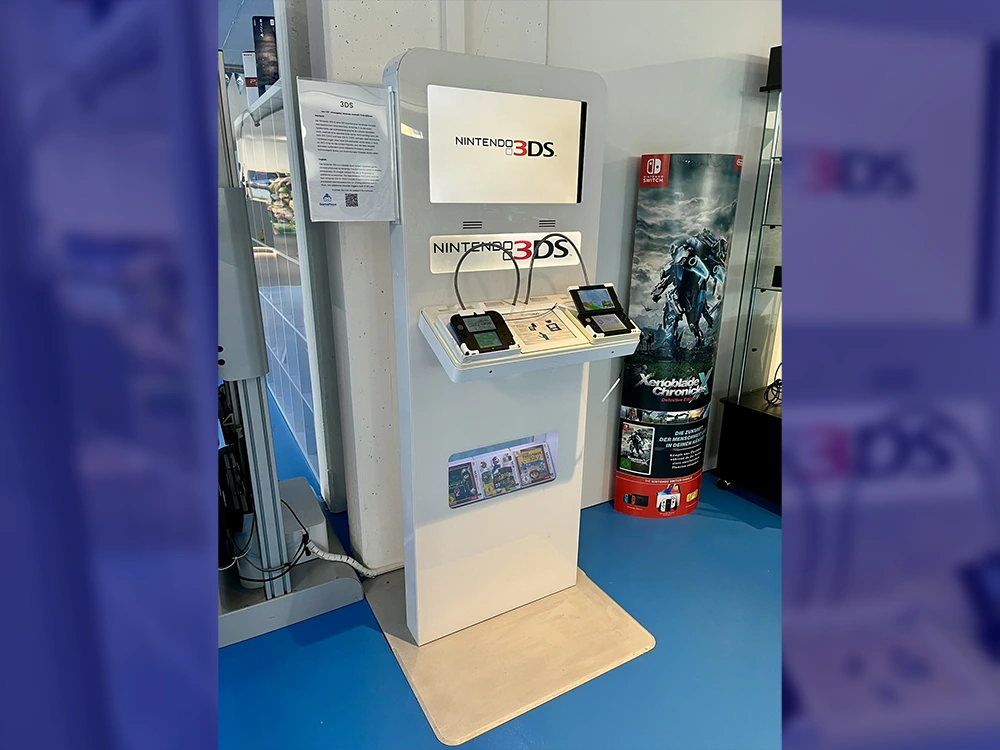
How to Choose and Change Games
The Nintendo 3DS supports both physical and digital games. Players can insert a Nintendo 3DS Game Card into the cartridge slot or launch downloaded software directly from the system’s home menu. This gave users flexibility between traditional physical collecting and the convenience of digital purchasing and storage.
Changing games is straightforward. Cartridge-based games can be switched by closing the current software, removing the inserted game card, and replacing it with another one. Digital titles can be selected directly from the home screen without changing physical media, making it easy for players to move between installed games, applications, and built-in features.
- Insert a Nintendo 3DS Game Card to start a physical game.
- Select an installed digital title from the home menu for downloadable play.
- Close the current software before removing a game card.
- Return to the home menu to switch between installed applications and games.
- Some software may require updates, save data, or SD card storage for additional content.
The Nintendo 3DS is also backward compatible with Nintendo DS software, which gave players access to a much larger portable game library. This added significant value to the system and helped make it attractive both to existing Nintendo fans and to new users entering the handheld ecosystem.
Game Library
The Nintendo 3DS has one of the strongest handheld software libraries of its generation. It combines major Nintendo franchises, creative touch-based games, role-playing adventures, multiplayer titles, and broad support from Japanese and international developers. Because of this, the system appealed to both long-time Nintendo players and people looking for a rich and varied portable gaming experience.
The console became especially associated with major series such as Mario Kart, Pokémon, The Legend of Zelda, Animal Crossing, Fire Emblem, Super Smash Bros., and Monster Hunter. These games helped define the system’s image and gave it a strong identity within the portable market. Nintendo’s first-party support was especially important, but the platform also benefited from a wide range of role-playing games, puzzle titles, remakes, and experimental releases.
One of the biggest advantages of the Nintendo 3DS library was its balance between continuity and innovation. It inherited ideas from the Nintendo DS era, but also introduced software that made better use of improved graphics, analog input, online features, StreetPass, and stereoscopic presentation. This made the platform feel both familiar and meaningfully advanced.
- Supports a large and varied handheld game library.
- Features many of Nintendo’s most important portable franchises.
- Benefits from strong first-party and third-party support.
- Includes role-playing games, platformers, racing games, life simulation, fighting games, and puzzle titles.
- Is also backward compatible with Nintendo DS games.
Most Popular Games
Several games became especially closely associated with the Nintendo 3DS because they showed the strength of the hardware and the appeal of the system’s software ecosystem. These titles helped define the 3DS era and remain some of the most recognized games in Nintendo’s portable history.
- Mario Kart 7 — One of the system’s most important racing titles and a major multiplayer showcase for portable Nintendo gaming.
- Pokémon X and Pokémon Y — Landmark entries in the Pokémon series that helped define the 3DS as a central platform for modern portable role-playing games.
- Animal Crossing: New Leaf — A hugely influential life-simulation title that became one of the most beloved games on the system.
- The Legend of Zelda: A Link Between Worlds — One of the defining action-adventure releases of the 3DS era and a major first-party success.
- Super Smash Bros. for Nintendo 3DS — A major portable fighting release that brought one of Nintendo’s biggest crossover franchises to handheld hardware.
These games mattered because they showed the Nintendo 3DS could succeed across many genres. The system was not defined by a single type of player or gameplay style, but by the strength and variety of its library as a whole.
History
The Nintendo 3DS was introduced as the successor to the Nintendo DS family, one of the most successful handheld lines in video game history. Nintendo needed a system that could continue the momentum of the DS while offering a clear new identity, and the company chose glasses-free stereoscopic 3D as the defining feature. This gave the console an immediately recognizable concept and helped separate it from both its predecessor and competing portable devices.
The system arrived during a period of major change in the portable market. Handheld game consoles were facing growing pressure from smartphones and tablets, which were expanding rapidly as gaming platforms. In response, the Nintendo 3DS had to offer more than basic portability. It needed to present a strong reason for players to choose a dedicated gaming handheld, and it did this through Nintendo-exclusive software, distinct hardware features, and a broader online ecosystem.
Although the Nintendo 3DS had a difficult start in some markets, it recovered strongly over time. Price adjustments, major software releases, and continued hardware revisions helped strengthen the platform and improve its long-term position. This made the 3DS an important example of how a system can recover from an uncertain early period and go on to build a strong identity and loyal player base.
The console later expanded into a full hardware family that included the Nintendo 3DS XL, New Nintendo 3DS, New Nintendo 3DS XL, Nintendo 2DS, and New Nintendo 2DS XL. These versions helped extend the life of the platform and allowed Nintendo to reach different audiences at different price points. As a result, the Nintendo 3DS became not just a single handheld, but an entire portable ecosystem.
- Released as the successor to the Nintendo DS family.
- Introduced glasses-free stereoscopic 3D as its defining feature.
- Entered the market during a period of growing smartphone competition.
- Recovered from an uncertain early phase through software strength and pricing changes.
- Expanded into a larger hardware family with multiple revisions and related models.
Hardware
The Nintendo 3DS was built around a dual-screen clamshell design, continuing the format established by the DS line. The upper screen provided the glasses-free 3D effect, while the lower touchscreen supported menus, maps, and direct gameplay interaction. This preserved a familiar Nintendo handheld structure while also introducing a new visual feature that gave the system its name.
The hardware included several additional functions that helped modernize Nintendo’s portable strategy. These included motion sensors, built-in cameras, wireless communication, online connectivity, and the Circle Pad analog control input. Together, these features gave developers more options than were available on earlier Nintendo handhelds and helped the system support a wider range of game styles.
Another important part of the Nintendo 3DS hardware identity was its broad family structure. Over time, Nintendo introduced larger versions, improved performance revisions, and 2D-only variants, allowing the core platform to serve different market segments. Even with these later changes, the original Nintendo 3DS remains especially important as the model that introduced the hardware concept and established the identity of the generation.
- Uses a dual-screen clamshell handheld design.
- Features a glasses-free stereoscopic 3D upper display.
- Includes a lower touchscreen for direct interaction.
- Supports cameras, motion controls, wireless communication, and online functions.
- Introduced the Circle Pad for analog-style movement in portable games.
Market Impact
The Nintendo 3DS had an important impact on the handheld market because it showed that dedicated portable gaming systems could still succeed in the smartphone era. Even as mobile gaming expanded, Nintendo maintained strong demand for a dedicated handheld by focusing on exclusive software, recognizable franchises, and hardware features designed specifically for games. This helped the 3DS remain one of the most significant portable platforms of the 2010s.
The system also showed how a hardware concept could evolve over time through revisions and family expansion. Instead of relying on a single model, Nintendo built a broader 3DS ecosystem that ranged from premium versions to lower-cost alternatives such as the 2DS. This strategy helped keep the platform relevant for years and allowed the company to target different kinds of players without splitting the software library.
Commercially, the Nintendo 3DS family became one of Nintendo’s major hardware successes of the decade. Its strongest impact came not only from unit sales, but also from how effectively it preserved Nintendo’s presence in the dedicated handheld space during a period of major change in the games industry. In this sense, the Nintendo 3DS served as both a successful product line and a strategic defense of portable gaming as a distinct category.
- Helped Nintendo remain strong in dedicated handheld gaming during the smartphone era.
- Showed the importance of exclusive software and hardware identity in the portable market.
- Expanded into a family of models that served multiple audiences and price levels.
- Maintained one unified software ecosystem across several hardware revisions.
- Became one of Nintendo’s most important handheld platforms of the 2010s.
Because of this, the Nintendo 3DS mattered not only as a hardware successor to the DS, but also as proof that dedicated handheld systems could remain culturally and commercially relevant in a rapidly changing market.
Fun Facts
The Nintendo 3DS is memorable not only because of its 3D display, but also because it represented Nintendo’s continued willingness to experiment within handheld design. It combined familiar elements from the DS with new technology, broader online features, and a software library that remained important for many years.
- It was one of the most famous handheld systems to feature glasses-free stereoscopic 3D.
- It remained compatible with Nintendo DS software, giving players access to an even larger library.
- StreetPass became one of the system’s most distinctive social features, encouraging players to carry the console with them.
- The 3DS family eventually included multiple revisions, including larger, faster, and 2D-only versions.
- It helped bridge the gap between the Nintendo DS era and later Nintendo hardware such as the Switch generation.
The Nintendo 3DS represents an important chapter in portable gaming history. With its glasses-free 3D display, strong game library, and long-lasting family of hardware revisions, it remains one of Nintendo’s most notable handheld systems. If you would like to explore that story more closely, visit Gameplaza in Altstetten, Zurich, where the Nintendo 3DS can be discovered as part of a wider journey through the past, present, and future of video games.
Important Info
| Also known as: | 3DS (shortened name) iQue 3DS (China) |
| Developer: | Nintendo Research & Engineering |
| Manufacturer: | Nintendo, Foxconn |
| Product family: | Nintendo 3DS family |
| Type: | Handheld game console |
| Generation: | Eighth |
| Release date: | Nintendo 3DS JP: February 26, 2011 EU: March 25, 2011 NA: March 27, 2011 AU: March 31, 2011 Nintendo 3DS XL Nintendo 3DS LL |
| Introductory price: | 3DS: ¥25,000, US$249.99, A$349.95 3DS XL: US$199.99, A$349.95 3DS LL: ¥18,900 |
| Discontinued: | WW: September 16, 2020 |
| Units shipped: | All models combined: 75.94 million (as of September 30, 2022) |
| Media: | Nintendo 3DS Game Card Nintendo DSi Game Card Nintendo DS Game Card Digital distribution SD/SDHC card |
| Operating system: | Nintendo 3DS system software |
| CPU: | Dual-core ARM11 MPCore @ 268 MHz Single-core ARM9 |
| Memory: | 128 MB FCRAM, 6 MB VRAM (Fujitsu MB82M8080-07L FC-RAM) |
| Storage: | 2 GB Toshiba eMMC Removable storage 3DS: 2 GB SD card (included) 3DS XL / 3DS LL: 4 GB SDHC card (included) |
| Display: | 2 TN LCD screens |
| Graphics: | DMP PICA200 @ 268 MHz |
| Sound: | Stereo speakers (pseudo-surround via Dolby Surround 2.0), microphone |
| Input: | A/B/X/Y buttons, Circle Pad, L/R bumpers, D-pad, 3D depth slider, volume slider, wireless switch, power button |
| Camera: | Rear: 2 × 0.3 MP, f/2.85 Front: 0.3 MP, f/2.85 480p @ 30 video recording |
| Connectivity: | 2.4 GHz 802.11b/g Wi-Fi, infrared |
| Power: | Nintendo 3DS: 1300 mAh, 3.7 V, 5 Wh lithium-ion battery Nintendo 3DS XL / Nintendo 3DS LL: 1750 mAh, 3.7 V lithium-ion battery |
| Current firmware: | 11.17.0-50 |
| Online services: | Nintendo Network (discontinued) |
| Mass: | 3DS: 235 grams (8.3 oz) 3DS XL: 336 grams (11.9 oz) |
| Best-selling game: | Mario Kart 7, 18.99 million units |
| Backward compatibility: | Nintendo DS Nintendo DSi |
| Predecessor: | Nintendo DS |
| Related: | Nintendo 2DS New Nintendo 3DS |