
Game Console
Dreamcast
The Dreamcast is a home video game console developed by Sega and released at the end of the 1990s as part of the sixth generation of video game hardware. It was the successor to the Sega Saturn and became Sega’s final home console. The system is especially remembered for its forward-looking design, distinctive software library, and important role in the transition toward more modern online and arcade-style console gaming.
The Dreamcast is important because it was both innovative and historically dramatic. It introduced features and ideas that were ahead of their time, yet it also marked the end of Sega as a console manufacturer. Because of this, the Dreamcast holds a special place in gaming history as both a creative success and a commercially difficult turning point.
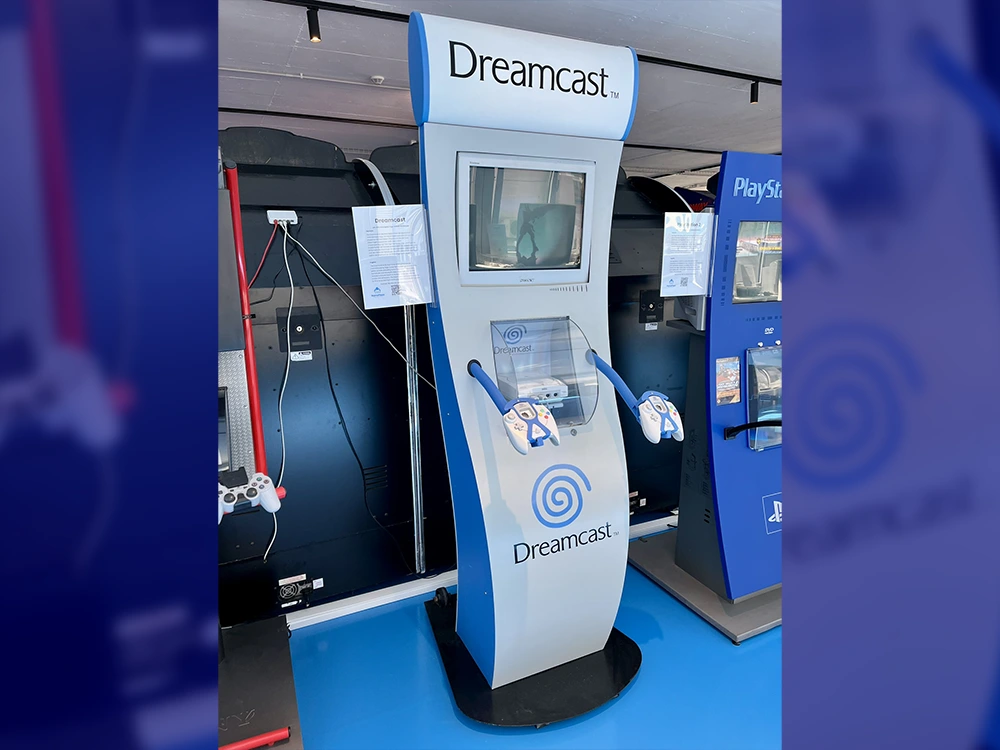
How to Choose and Change Games
The Dreamcast uses optical game discs, so players choose a game by inserting the disc they want to play. Only one disc can be active at a time, and the system reads the inserted media directly. This makes game selection straightforward and closer to later disc-based consoles than to cartridge-based systems from earlier generations.
To change games, the user opens the console lid, removes the current disc, inserts another one, and allows the system to load the new title. This process is simple and gives the Dreamcast a familiar home-console feel, while also reflecting the industry-wide move toward optical media at the time.
- Choose a game by selecting its disc.
- Open the console lid to insert the disc.
- Remove the current disc before changing games.
- Load the new game directly from the optical drive.
- Use memory cards to save progress and settings.
Game Library
The Dreamcast is remembered for having one of the most distinctive and beloved software libraries of its era. Although the console had a relatively short commercial life, it received a strong range of arcade conversions, action games, sports titles, fighting games, role-playing games, and experimental releases. Its library helped give the system a creative identity that remains highly respected today.
Many Dreamcast games are remembered for being fast, colorful, inventive, and closely tied to Sega’s arcade heritage. The console became known for titles that felt energetic and unusual, which helped it build a loyal following even after Sega left the console market. Because of this, the Dreamcast’s software reputation is one of the main reasons it remains so admired.
- Known for a strong and distinctive game library.
- Featured many arcade-style titles and conversions.
- Included action, fighting, sports, and role-playing games.
- Had a shorter market life but strong creative output.
- Remains highly respected by collectors and retro players.
Most Popular Games
Several games became especially associated with the Dreamcast because they helped define the console’s personality and showed off its technical and creative strengths.
- Sonic Adventure – One of the console’s most iconic launch-era titles and a major part of Dreamcast’s identity.
- Shenmue – A highly ambitious and historically important game known for its scale and cinematic design.
- Crazy Taxi – A fast and energetic arcade-style game that became one of the system’s signature experiences.
- Jet Set Radio – A visually distinctive and stylistically bold title strongly linked to the Dreamcast’s identity.
- Soulcalibur – One of the most acclaimed fighting games of its era and an important showcase for the console.
These games matter because they show the range of what the Dreamcast offered, from mascot platforming and open-world ambition to arcade action and stylish experimentation.
History
The Dreamcast was released after Sega’s difficult Saturn era and represented a major effort to recover its position in the console market. Sega designed the system to be more developer-friendly, technically modern, and commercially appealing, and the console initially drew strong attention for its launch and software lineup.
However, despite its innovation and positive reputation, the Dreamcast struggled in a highly competitive market. The arrival of stronger competition and Sega’s earlier business problems made it difficult for the console to maintain momentum. As a result, the Dreamcast became Sega’s last home console, bringing an end to the company’s direct role in console hardware manufacturing.
- Released as Sega’s successor to the Saturn.
- Represented Sega’s effort to recover in the console market.
- Introduced modern features and a strong launch identity.
- Faced heavy competition during the early 2000s.
- Became Sega’s final home video game console.
Hardware
The Dreamcast hardware was advanced for its time and is one of the main reasons the console is remembered as forward-looking. It used optical discs, supported memory devices inserted directly into the controller, and offered features associated with a more connected and modern gaming experience. Its overall design balanced arcade power with home console accessibility.
The system is also remembered for its Visual Memory Unit, often called the VMU, which functioned as both a memory card and a small accessory screen. This gave the Dreamcast a unique identity and made its hardware feel more playful and inventive than many competing systems.
- Used optical discs for software.
- Included support for memory cards and controller accessories.
- Featured the distinctive VMU memory device.
- Reflected a more modern and connected hardware philosophy.
- Remains highly recognizable in console design history.
Market Impact
The Dreamcast’s market impact is best understood through its hardware sales figures. Across its lifetime, the console sold roughly 9 million units worldwide, placing it well below the biggest commercial successes of its generation. This sales total shows that, despite its strong reputation and loyal fan base, the Dreamcast was not able to achieve the large installed base needed for long-term market dominance.
These sales numbers are especially significant because they help explain why Sega exited the console hardware business after the Dreamcast era. The system achieved meaningful global sales, but not enough to compete sustainably against its major rivals. In pure commercial terms, the Dreamcast remains an example of a respected console with relatively modest lifetime hardware sales.
- About 9 million units sold worldwide over its lifetime.
- Sold far less than the leading sixth-generation consoles.
- Did not build a large enough installed base for long-term hardware competition.
- Its sales performance contributed to Sega’s exit from the home console market.
- Remains commercially modest despite its strong historical reputation.
Because of this, the Dreamcast’s sales story is one of contrast: it is remembered with great affection and respect, but its market footprint was much smaller than its cultural legacy might suggest.
Fun Facts
The Dreamcast is one of the most beloved “what if” consoles in gaming history. Many players and historians see it as a system that was ahead of its time in both style and ideas.
- It was Sega’s final home console.
- It is famous for the Visual Memory Unit, or VMU.
- It built a strong reputation despite a short commercial life.
- It is often seen as one of the most innovative consoles of its era.
- Its fan community remains especially passionate today.
The Dreamcast represents one of the most fascinating chapters in video game history, combining innovation, creativity, and commercial struggle in a single machine. With its memorable software, distinctive hardware, and lasting fan admiration, it remains one of Sega’s most important and emotional hardware legacies. If you would like to explore that story more closely, visit Gameplaza in Altstetten, Zurich, where the Dreamcast can be discovered as part of a wider journey through the past, present, and future of video games.
Important Info
| Manufacturer: | Sega |
| Type: | Home video game console |
| Generation: | Sixth |
| Release date: | JP: November 27, 1998 NA: September 9, 1999 EU: October 14, 1999 |
| Lifespan: | 1998/99–2001/02 |
| Introductory price: | ¥29,000 (equivalent to ¥29,400 in 2019) US$199 (equivalent to $360 in 2023) £200 (equivalent to £440 in 2023) |
| Discontinued: | WW: March 31, 2001 |
| Units sold: | 9.13 million |
| Media: | 1 GB GD-ROM, CD-ROM, Mini-CD |
| Operating system: | Proprietary |
| CPU: | Hitachi SH-4 @ 200 MHz |
| Memory: | 16 MB RAM, 8 MB video RAM, 2 MB audio RAM |
| Removable storage: | 128 KB VMU |
| Display: | Video output formats |
| Graphics: | 100 MHz PowerVR2, integrated with the system’s ASIC |
| Sound: | 67 MHz Yamaha AICA with 32-bit ARM7 RISC CPU core, 64 channels |
| Online services: | Dricas, SegaNet, Dreamarena |
| Dimensions: | 195.8 mm × 190 mm × 75.5 mm (7.71 in × 7.48 in × 2.97 in) |
| Mass: | 1.5 kg (3.3 lb) |
| Best-selling game: | Sonic Adventure, 2.5 million sold |
| Predecessor: | Sega Saturn |