
Game Console
Nintendo Switch
The Nintendo Switch is a hybrid home video game console developed by Nintendo and released in March 2017. It was designed to function both as a traditional home console connected to a television and as a portable handheld device, giving players the freedom to switch between the two modes seamlessly. Because of this flexible approach, the Nintendo Switch became one of the most innovative and commercially successful consoles in gaming history, redefining what a home gaming system could be.
The console is important because it represented Nintendo’s boldest hardware idea in years. After the mixed commercial performance of the Wii U, Nintendo needed a product that could reunite its home and portable gaming audiences under a single platform. The Switch achieved exactly that, bringing together a distinctive concept, a strong software lineup, and a play style suited to modern life. This made it not only a commercial triumph but also a turning point in how the industry thought about the relationship between home and portable gaming.
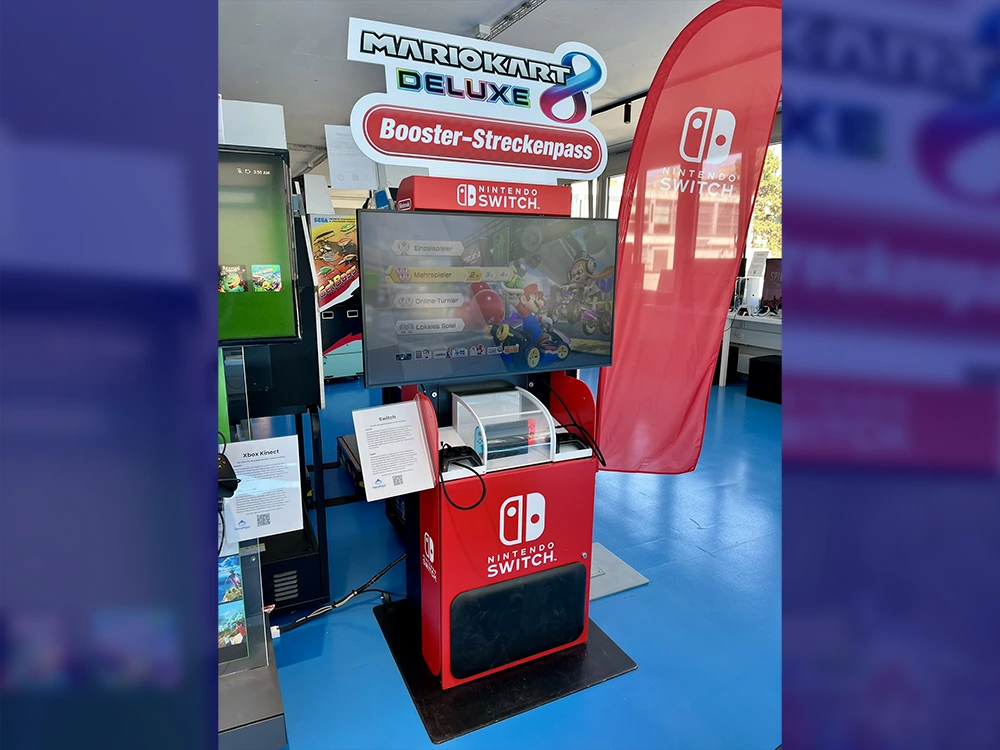
How to Choose and Change Games
GamePlaza Note: To change game, press the “Home” button in the center of the controller to return to the menu. Use “A” button to select a new game.
The Nintendo Switch supports both physical and digital games. Players can insert a game card into the card slot on the top of the console to launch a physical title, or they can select an installed digital game directly from the home menu. This gives players a genuine choice between the traditions of physical collecting and the convenience of a fully digital library stored on internal memory or a microSD card.
Changing games on the Switch is simple regardless of the format. Physical game cards can be swapped by removing the current card and inserting another, while digital titles can be selected from the home screen at any time without any physical action. The system also allows multiple user profiles, so different players in a household can each maintain their own game libraries and save data independently.
- Insert a physical game card into the top slot to launch a disc-free cartridge-based title.
- Choose a digital game from the home menu to play without physical media.
- Remove the current game card before inserting another for physical titles.
- Switch between installed titles instantly from the main screen.
- Support for microSD cards allows expanded storage for large digital libraries.
- Multiple user profiles let different players maintain separate save files on the same system.
Game Library
The Nintendo Switch has one of the strongest and most diverse software libraries in the history of home gaming. It combines Nintendo’s own first-party titles with broad third-party and independent developer support, resulting in a catalog that spans virtually every genre and play style. Because the console sold so well and reached such a large audience, publishers were motivated to bring major releases to the platform alongside platform-exclusive titles.
The library became especially notable for the quality of its Nintendo-developed software. Games like The Legend of Zelda: Breath of the Wild and Tears of the Kingdom, Super Mario Odyssey, Animal Crossing: New Horizons, and Splatoon 2 and 3 set a very high standard for the platform. At the same time, the Switch also became home to significant third-party releases and an extraordinarily vibrant independent game scene, making its catalog one of the most varied available on any single console.
- Supports a vast library covering action, adventure, role-playing, sports, racing, puzzle, and fighting games.
- Features some of the most critically acclaimed Nintendo first-party titles ever released.
- Includes strong third-party support from major global publishers.
- Home to one of the richest independent game catalogs on any console platform.
- Accessible to players of all ages and experience levels.
- Compatible across all Switch hardware models including the Switch Lite and Switch OLED.
Most Popular Games
Several titles became defining games of the Switch era, both commercially and critically. These releases helped establish the console’s identity and demonstrated the full range of what the platform could offer.
- The Legend of Zelda: Breath of the Wild — A landmark open-world adventure game that launched alongside the console and redefined exploration in the Zelda franchise.
- The Legend of Zelda: Tears of the Kingdom — A critically acclaimed sequel that expanded the open-world concept further and became one of the best-reviewed games of its generation.
- Super Mario Odyssey — A joyful and inventive 3D platformer that showcased the playful identity of Nintendo’s flagship franchise at its best.
- Animal Crossing: New Horizons — A life-simulation game that became a global cultural phenomenon, especially during 2020, and sold over 43 million copies worldwide.
- Mario Kart 8 Deluxe — The best-selling Switch title of all time, a refined racing experience that became a staple in households around the world.
- Splatoon 2 and Splatoon 3 — Nintendo’s distinctive multiplayer shooter franchise, which found a major audience on the Switch platform.
- Pokémon Sword and Shield / Scarlet and Violet — Major entries in one of gaming’s most enduring franchises, bringing mainline Pokémon games to a home console for the first time.
- Super Smash Bros. Ultimate — A comprehensive fighting game featuring the largest roster in the series’ history, celebrated as one of the definitive multiplayer experiences on the platform.
These games mattered because together they demonstrated how the Nintendo Switch could serve as both a living room entertainment system and a personal portable device, all while hosting some of the generation’s most important software releases.
History
The Nintendo Switch was officially revealed in October 2016 and launched worldwide in March 2017. Its debut was accompanied by The Legend of Zelda: Breath of the Wild, one of the most celebrated launch titles in console history, which helped generate immediate critical and commercial enthusiasm for the new platform. The combination of the hardware concept and the strength of its launch software gave the Switch one of the strongest debuts Nintendo had seen in years.
The console arrived after the Wii U, which had struggled commercially throughout its lifespan from 2012 to 2017. The Wii U’s unclear identity and limited third-party support had left Nintendo in a weakened position, and the Switch was developed partly as a response to those lessons. The portable-home hybrid format gave the system a clear and immediately communicable purpose, which the Wii U had lacked, and this clarity proved central to the Switch’s success.
Nintendo expanded the Switch family with the portable-only Nintendo Switch Lite in September 2019, and then released the premium Nintendo Switch OLED Model in October 2021, which featured a larger, higher-quality OLED screen. Each model targeted a slightly different segment of the audience while remaining fully compatible with the same game library. By early 2025, the Nintendo Switch had sold over 150 million units worldwide, making it one of the best-selling consoles in gaming history.
- Revealed in October 2016 and launched globally in March 2017.
- Released alongside The Legend of Zelda: Breath of the Wild as a landmark launch title.
- Followed the Wii U, applying lessons from that console’s mixed commercial performance.
- Expanded with the Switch Lite in September 2019 and the Switch OLED Model in October 2021.
- Sold over 150 million units worldwide, making it one of the best-selling consoles ever made.
- Continued to receive major software support well beyond its original hardware generation.
Hardware
The Nintendo Switch is built around a central tablet-style unit that docks into a TV dock for home play and detaches for handheld use. The controller setup is one of the most distinctive features of the hardware: two Joy-Con controllers attach to the sides of the tablet for portable play, can be removed and used as individual controllers for multiplayer, or can be inserted into the Joy-Con Grip accessory to function as a traditional gamepad. This flexibility was central to the console’s hybrid identity.
The system runs on a custom NVIDIA Tegra processor and features a built-in touchscreen, motion controls, HD rumble feedback in the Joy-Con controllers, and support for local wireless multiplayer between multiple Switch units. The home television output produces up to 1080p video through HDMI, while handheld mode runs at 720p. The OLED Model updated the screen to a larger 7-inch OLED panel, improved audio, and a wider adjustable stand, refining the portable experience considerably.
- Hybrid design that functions as both a home console and a portable handheld device.
- Detachable Joy-Con controllers support a wide range of play styles and configurations.
- Custom NVIDIA Tegra processor with touchscreen and motion control support.
- Outputs up to 1080p via HDMI when docked, and 720p in portable mode.
- Joy-Con controllers include HD Rumble for nuanced tactile feedback.
- Nintendo Switch OLED Model features a 7-inch OLED screen and enhanced audio.
- Nintendo Switch Lite is a dedicated portable model with integrated controls.
Market Impact
The Nintendo Switch had a transformative impact on the gaming market. It proved that a hybrid concept could succeed commercially on a massive scale and helped reestablish Nintendo as one of the most important players in the global console industry. After the difficulties of the Wii U era, the Switch restored confidence in Nintendo’s hardware direction and demonstrated that the company’s approach to game design and platform identity remained highly relevant.
The console’s success also had an important effect on how the industry thought about portable gaming. While dedicated handheld consoles had been declining in commercial importance as smartphones became dominant, the Switch showed that there was still a large audience for a premium portable gaming device when paired with compelling software and a flexible design. This opened a discussion about the future of hybrid hardware that continued well beyond the Switch itself.
In broader commercial terms, the Switch’s performance across its lifespan was extraordinary. Titles such as Mario Kart 8 Deluxe exceeded 67 million copies sold, Animal Crossing: New Horizons exceeded 43 million, and Super Smash Bros. Ultimate surpassed 35 million, making the Switch one of the most software-rich console generations in gaming history. These numbers confirmed that Nintendo had built one of the most commercially powerful single-platform ecosystems the industry had ever seen.
- Sold over 150 million units worldwide, ranking among the best-selling consoles of all time.
- Helped reestablish Nintendo’s commercial dominance after the Wii U era.
- Demonstrated the viability of hybrid home and portable console design at a mainstream level.
- Hosted multiple titles that individually sold tens of millions of copies.
- Strengthened the case for premium portable gaming in the era of mobile smartphones.
- Influenced hardware strategy discussions across the gaming industry.
Because of this, the Nintendo Switch stands as one of the most significant consoles in modern gaming history. It did not only sell well — it changed expectations for what a home console could be and helped set the direction for the next generation of hybrid gaming hardware.
Fun Facts
The Nintendo Switch is memorable for many reasons beyond its commercial performance. Its unique design, its cultural moments, and the way it brought players together in new contexts made it one of the most talked-about consoles of its generation.
- The Switch launched with The Legend of Zelda: Breath of the Wild, which many critics considered one of the greatest games ever made at the time of its release.
- Animal Crossing: New Horizons, released in March 2020, became a cultural phenomenon during a period of global lockdowns and sold over 43 million copies worldwide.
- Mario Kart 8 Deluxe became the best-selling Nintendo Switch game ever, exceeding 67 million units sold.
- The Switch is the first Nintendo console to unify the company’s home and portable development teams under a single platform.
- The Joy-Con controllers can each function as independent mini-controllers, allowing two players to share one set of controllers for local multiplayer.
- The Nintendo Switch OLED Model was released in 2021 without a performance upgrade, focusing entirely on the quality of the portable screen experience.
- The Nintendo Switch 2 was announced as the successor system, continuing the hybrid design concept Nintendo established with the original Switch.
The Nintendo Switch represents a landmark in the history of home gaming hardware, proving that a flexible concept, strong software, and a clear sense of purpose can create one of the most successful gaming platforms ever built. Its legacy will be felt in the design of gaming hardware for years to come. If you would like to explore that story more closely, visit Gameplaza in Altstetten, Zurich, where the Nintendo Switch can be discovered as part of a wider journey through the past, present, and future of video games.
Important Info
| Also known as: | NXHAC (Nintendo code names) Odin (Nvidia code name) |
| Developer: | Nintendo PTD |
| Manufacturer: | Foxconn, Hosiden |
| Product family: | Nintendo Switch |
| Type: | Video game console |
| Generation: | Eighth / Ninth |
| Release date: | WW: March 3, 2017 CHN: December 10, 2019 |
| Availability: | 2017–present |
| Lifespan: | 2017–present |
| Introductory price: | US$299.99 ¥29,980 £279.99 €329.99 |
| Units shipped: | 143.42 million (as of June 30, 2024) |
| Media: | Game card, digital distribution |
| Operating system: | Nintendo Switch system software |
| System on a chip: | Nvidia Tegra X1 / Tegra X1+ |
| CPU: | ARM 4 Cortex-A57 cores @ 1.02 GHz |
| Memory: | 4 GB LPDDR4 @ 1,331/1,600 MHz |
| Storage: | 32 GB / 64 GB eMMC |
| Removable storage: | microSD/HC/XC (up to 2 TB) |
| Display: | Nintendo Switch: 6.2-inch, 1280 × 720 IPS (237 ppi) Nintendo Switch Lite: 5.5-inch, 1280 × 720 IPS (267 ppi) Nintendo Switch OLED: 7-inch, 1280 × 720 OLED (210 ppi) Docked: 480p / 720p / 1080p via HDMI |
| Graphics: | 256 Maxwell-based CUDA cores Undocked: 307 MHz, 236 GFLOPS Docked: 768 MHz, 393 GFLOPS |
| Sound: | Undocked: Linear PCM 2.0 ch stereo speakers (with pseudo-surround) Docked: Linear PCM 5.1 ch |
| Input: | Volume +/−, power buttons |
| Controller input: | Joy-Con Nintendo Switch Pro Controller |
| Camera: | Ambient light sensor |
| Touchpad: | Multi-touch capacitive |
| Connectivity: | Wi-Fi 5 @ 2.4 / 5 GHz Bluetooth 4.1 1 × USB-C Headphone jack Dock |
| Power: | 3.7 V 15.95 Wh (4,310 mAh) Li-ion battery Duration: 2.5–6.5 hours / 4.5–9 hours Charger: 7.5 W 5.0 V 1.5 A / 39 W 15.0 V 2.6 A |
| Current firmware: | 18.1.0 (as of June 10, 2024) |
| Online services: | Nintendo eShop Nintendo Switch Online |
| Dimensions: | Nintendo Switch: Width 173 mm (6.8 in), Height 102 mm (4.0 in), Depth 14 mm (0.55 in) Nintendo Switch Lite: Width 208 mm (8.2 in), Height 91 mm (3.6 in), Depth 14 mm (0.55 in) Nintendo Switch OLED: Width 176 mm (6.9 in), Height 102 mm (4.0 in), Depth 14 mm (0.55 in) |
| Mass: | Nintendo Switch: 297 g (10.5 oz) Nintendo Switch Lite: 277 g (9.8 oz) Nintendo Switch OLED: 319 g (11.3 oz) |
| Best-selling game: | Mario Kart 8 Deluxe (62.90 million, as of June 30, 2024) |
| Predecessor: | Wii U |
| Related: | Nintendo Switch Lite |
| Website: | nintendo.com/switch |