
Game Console
Wii U
The Wii U is a home video game console developed by Nintendo and released in November 2012. It was the successor to the enormously successful Wii and introduced one of the most distinctive hardware concepts of its generation: a dedicated GamePad controller featuring a built-in touchscreen, allowing players to interact with games in new ways and continue playing on the controller screen even when the television was unavailable. Because of this, the Wii U became one of the most creatively ambitious consoles Nintendo had ever produced.
The console is important because it represented a significant moment of transition for Nintendo. Despite its innovative design and a number of genuinely outstanding games, the Wii U struggled commercially throughout its lifespan and was ultimately discontinued in 2017. However, its legacy proved far more lasting than its sales figures suggested. Many of its best ideas, and several of its most celebrated games, directly influenced and shaped the Nintendo Switch that followed it, making the Wii U an essential chapter in understanding modern Nintendo history.
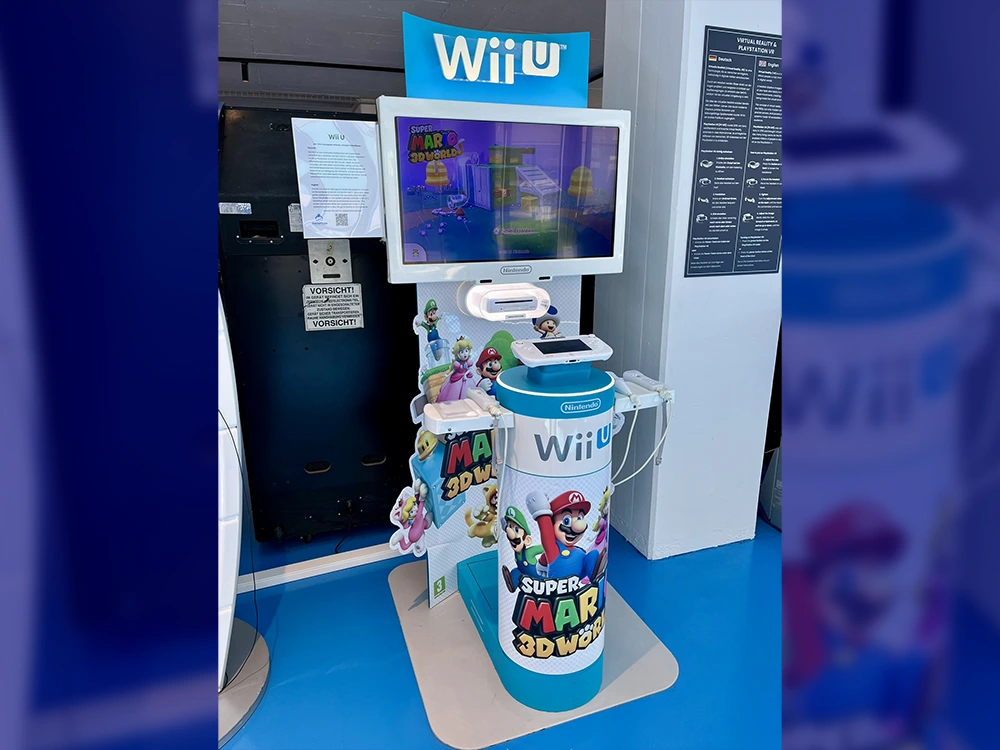
How to Choose and Change Games
GamePlaza Note: To change game, press the “Home” button in the center of the controller to return to the menu. Use “A” button to select a new game.
The Wii U supports both physical and digital games. Physical titles come on proprietary optical discs that are inserted into the disc drive on the front of the console, while digital games can be purchased and downloaded through the Nintendo eShop and stored on the internal memory or an external USB storage device. This gave players flexibility between physical collecting and the convenience of a growing digital library.
Changing games on the Wii U is straightforward. Disc-based titles can be swapped by ejecting the current disc and inserting another, while digital titles can be selected directly from the main menu at any time. The system also supported Wii backward compatibility, meaning players could use original Wii remotes and play Wii discs directly on the Wii U, making it one of the few consoles of its era to offer a full cross-generational physical game library.
- Insert a proprietary optical disc into the front of the console to play a physical game.
- Select a downloaded title from the main menu for digital play.
- Eject the current disc before inserting another for physical titles.
- External USB storage can be connected to expand the digital game library.
- The Wii U is backward compatible with Wii discs and original Wii accessories.
- Some games require additional downloads or updates before first use.
Game Library
The Wii U’s game library was one of the most interesting of its generation, even if it remained smaller than those of competing platforms. Nintendo’s own first-party software was the heart of the catalog, and the quality of these titles was consistently high. The system became home to some of the most celebrated Nintendo games of the decade, even as it struggled to attract consistent support from major third-party publishers.
Third-party support, which had been a significant challenge for the Wii before it, proved even more difficult to sustain on the Wii U. Many major publishers released titles on the system early in its life but reduced their commitment as the platform’s commercial performance disappointed. Despite this, the first-party lineup gave the Wii U genuine value, and several of its games later found new audiences when they were re-released or remastered on the Nintendo Switch.
- Strong first-party Nintendo software formed the core of the library.
- Third-party support was initially present but declined over the console’s lifespan.
- Included backward compatibility with the Wii library of disc-based games.
- Featured games across platformers, action, racing, fighting, role-playing, and sports genres.
- Several key titles were later ported or remastered for the Nintendo Switch.
- Supported off-TV play on the GamePad screen as a unique feature of many titles.
Most Popular Games
Despite its commercial challenges, the Wii U produced a remarkable number of critically acclaimed games. Several of these titles are still regarded as among the finest Nintendo has ever made and helped justify the platform’s place in gaming history.
- Super Mario 3D World — A brilliant and joyful multiplayer platformer that made inventive use of the GamePad and became one of the console’s most beloved exclusives.
- The Legend of Zelda: The Wind Waker HD — A beautifully remastered version of the GameCube classic, widely praised as one of the finest entries in the Zelda series.
- The Legend of Zelda: Twilight Princess HD — Another high-quality remaster that brought a celebrated Zelda adventure to the platform with improved visuals and GamePad integration.
- Mario Kart 8 — A highly acclaimed racing game and one of the best-selling Wii U titles, later reissued as Mario Kart 8 Deluxe on the Nintendo Switch where it became the best-selling Switch game of all time.
- Splatoon — A completely original Nintendo multiplayer shooter that debuted on the Wii U and launched what became one of the company’s most important new franchises.
- Super Smash Bros. for Wii U — A polished and content-rich entry in Nintendo’s celebrated fighting series, regarded as one of the strongest versions in the franchise.
- Pikmin 3 — A visually stunning and creatively designed strategy title that showcased the Wii U’s graphical capabilities and GamePad features effectively.
- Bayonetta 2 — A critically acclaimed action game developed by PlatinumGames and published exclusively by Nintendo, frequently listed among the greatest action games ever made.
These games mattered because they showed that the Wii U, despite its commercial difficulties, was capable of hosting genuinely exceptional software. Many of them influenced the games that followed on the Nintendo Switch and helped preserve the Wii U’s creative reputation long after the hardware itself was discontinued.
History
The Wii U was announced at E3 2011 and released in North America in November 2012, followed by European and Australian launches shortly after. It launched with a price point and a hardware identity that many consumers found confusing. The GamePad, while genuinely innovative, was difficult to communicate as a meaningful upgrade over the original Wii, and many players initially misunderstood the Wii U as an accessory for the existing console rather than an entirely new system.
Early sales were slower than Nintendo had hoped, and the situation became more difficult as major third-party publishers began to step back from the platform in 2013 and 2014. The arrival of the PlayStation 4 and Xbox One in late 2013 drew attention and development resources away from the Wii U, leaving Nintendo increasingly dependent on its own internal studios to sustain the system’s software output. While those studios delivered outstanding results, the reduced release frequency made it harder for the platform to maintain momentum.
Nintendo officially discontinued the Wii U in January 2017, just before the launch of the Nintendo Switch. Over its lifespan, the console sold approximately 13.56 million units worldwide, making it one of Nintendo’s least commercially successful home consoles. However, its creative contributions, including the birth of Splatoon, the development of ideas that fed directly into the Switch, and the production of multiple landmark games, ensured that its place in Nintendo’s history remained significant despite those sales numbers.
- Announced at E3 2011 and launched in North America in November 2012.
- Suffered from marketing challenges that caused consumer confusion about the product identity.
- Lost significant third-party support as the PlayStation 4 and Xbox One launched in 2013.
- Sold approximately 13.56 million units worldwide over its lifespan.
- Officially discontinued in January 2017 ahead of the Nintendo Switch launch.
- Served as a direct creative foundation for many ideas later developed in the Nintendo Switch.
Hardware
The Wii U’s most distinctive hardware feature was the GamePad, a controller with a 6.2-inch resistive touchscreen built into its face. The GamePad allowed developers to create asymmetric gameplay experiences where the player holding it saw different information from those watching the television, and it enabled off-TV play so users could continue gaming directly on the controller screen even if another person was using the television. This concept was genuinely original and unlike anything offered by competing platforms at the time.
The console used a custom IBM PowerPC-based multi-core processor and a custom AMD GPU, delivering HD output up to 1080p over HDMI. This marked a significant technical step up from the original Wii, which had operated at standard definition. The system also included Near Field Communication support in the GamePad for use with Nintendo’s Amiibo figurines, as well as support for original Wii remotes and accessories for backward-compatible Wii titles.
- Features the GamePad controller with a built-in 6.2-inch resistive touchscreen.
- Supports asymmetric gameplay where the GamePad player sees different content from the TV.
- Enables off-TV play, allowing games to be played entirely on the GamePad screen.
- Outputs up to 1080p HD video through HDMI.
- Custom IBM PowerPC multi-core CPU paired with a custom AMD GPU.
- NFC support in the GamePad for use with Amiibo figurines.
- Backward compatible with Wii discs and original Wii Remote accessories.
Market Impact
The Wii U’s commercial performance was a significant setback for Nintendo at the time. After the Wii had sold over 101 million units and become a household name, the Wii U’s 13.56 million units represented one of the sharpest declines in console successor performance in gaming history. This outcome affected Nintendo’s standing in the market during the mid-2010s and directly shaped the company’s decision-making during the development of the Switch.
However, the Wii U’s market impact was not entirely negative. The lessons learned from its failure were arguably as important as those from its successes. Nintendo studied what had gone wrong with the platform’s identity, its third-party relationships, and its communication strategy, and applied those lessons to the Switch with transformative results. In this way, the Wii U’s difficulties became one of the most productive failures in Nintendo’s history.
The console also had a lasting impact through the games it produced. Mario Kart 8 sold approximately 8.46 million units on the Wii U before being reissued as Mario Kart 8 Deluxe on the Switch, where it eventually surpassed 67 million copies sold. Splatoon launched as a new franchise on the Wii U and became one of Nintendo’s most important ongoing series. Super Mario 3D World was reissued on the Switch with expanded content. These migrations showed that the Wii U’s creative output had a value that outlasted the hardware itself.
- Sold approximately 13.56 million units, making it one of Nintendo’s least commercially successful home consoles.
- Prompted important internal lessons that directly informed the Nintendo Switch concept.
- Launched Splatoon, which became one of Nintendo’s most successful ongoing franchises.
- Produced several games later ported to the Switch, where they reached much larger audiences.
- Demonstrated the risks of unclear console identity and insufficient third-party support.
- Contributed to a broader industry discussion about console differentiation and hybrid design.
Because of this, the Wii U occupies a unique position in gaming history. It is remembered both as a commercial disappointment and as a creative proving ground that gave Nintendo some of its most important ideas, franchises, and lessons. Without the Wii U, the Nintendo Switch might have looked very different.
Fun Facts
The Wii U is one of the most fascinating consoles in Nintendo history precisely because of the contrast between its commercial performance and its creative legacy. It produced world-class games, introduced original ideas, and laid the groundwork for one of the most successful consoles ever made, all while struggling to find a wide audience of its own.
- The Wii U was the first Nintendo home console to support HD output, a significant step up from the standard-definition Wii.
- Splatoon, one of Nintendo’s most successful new franchises in decades, debuted exclusively on the Wii U in 2015.
- Bayonetta 2, published by Nintendo for the Wii U, is still frequently cited as one of the greatest action games ever made.
- Mario Kart 8 on the Wii U was later reissued as Mario Kart 8 Deluxe on the Switch, where it became the best-selling Switch game of all time with over 67 million copies sold.
- The GamePad’s off-TV play concept was a direct ancestor of the Nintendo Switch’s portable handheld mode.
- The Wii U was backward compatible with the Wii, making it one of the few home consoles to support two full generations of physical game libraries simultaneously.
- Nintendo’s eShop on the Wii U was shut down in March 2023, ending digital purchases for the platform and making physical copies of its games increasingly important for preservation.
The Wii U represents one of the most instructive stories in the history of home gaming hardware. It showed that innovation alone is not enough, that communication and market positioning matter just as much as the ideas behind a product. Yet its creative legacy, the games it produced and the concepts it pioneered, proved enduring enough to shape one of the most successful consoles ever built. If you would like to explore that story more closely, visit Gameplaza in Altstetten, Zurich, where the Wii U can be discovered as part of a wider journey through the past, present, and future of video games.
Important Info
| Codename: | Project Café |
| Developer: | Nintendo IRD, NTD |
| Manufacturer: | Nintendo, Foxconn, Mitsumi |
| Type: | Home video game console |
| Generation: | Eighth |
| Release date: | NA: November 18, 2012 PAL: November 30, 2012 JP: December 8, 2012 |
| Introductory price: | US$299 / ¥26,250 (Basic Set) US$349 / ¥31,500 (Deluxe/Premium Set) |
| Discontinued: | WW: January 31, 2017 |
| Units sold: | Worldwide: 13.56 million (as of December 31, 2019) |
| Media: | Physical and digital |
| Operating system: | Wii U system software |
| CPU: | 1.24 GHz tri-core IBM PowerPC “Espresso” |
| Memory: | 2 GB DDR3 |
| Storage: | Internal flash memory: 8 GB (Basic Set) / 32 GB (Deluxe Set) |
| Removable storage: | SD/SDHC card (up to 32 GB) USB storage device (up to 2 TB) |
| Display: | Video output formats Wii U GamePad (FWVGA) |
| Graphics: | 550 MHz AMD Radeon-based “Latte”, 352 GFLOPS |
| Sound: | 5.1 linear PCM, analog stereo |
| Controller input: | Wii U GamePad Wii U Pro Controller Nintendo 3DS (select games and applications only) Wii Remote (Plus) |
| Camera: | 1.3 megapixels (Wii U GamePad) |
| Touchpad: | Resistive touchscreen (Wii U GamePad) |
| Connectivity: | Wi-Fi IEEE 802.11 b/g/n Bluetooth 4.0 4 × USB 2.0 |
| Power: | 75 W |
| Current firmware: | 5.5.6 |
| Online services: | Nintendo Network |
| Dimensions: | Width: 17.2 cm (6.8 in) Height: 4.6 cm (1.8 in) Length: 26.9 cm (10.6 in) |
| Mass: | 1.5 kg (3.3 lb) |
| Best-selling game: | Mario Kart 8, 8.46 million |
| Backward compatibility: | Wii |
| Predecessor: | Wii |
| Successor: | Nintendo Switch |