
Game Console
PlayStation 1
The PlayStation, often called the PlayStation 1, PS1, or original PlayStation, is Sony’s first home video game console and one of the most important systems in video game history. Released in the mid-1990s, it marked Sony’s entry into the console market and quickly became a major competitor to Nintendo and Sega. The system is especially remembered for helping bring 3D gaming into the mainstream and for establishing the PlayStation brand as a dominant force in home entertainment.
The console is important because it changed the direction of the game industry. It helped popularize CD-based gaming, attracted strong third-party support, and built a broad audience through a huge library of action, racing, role-playing, fighting, and adventure games. Because of this, the original PlayStation became one of the defining consoles of the fifth generation.
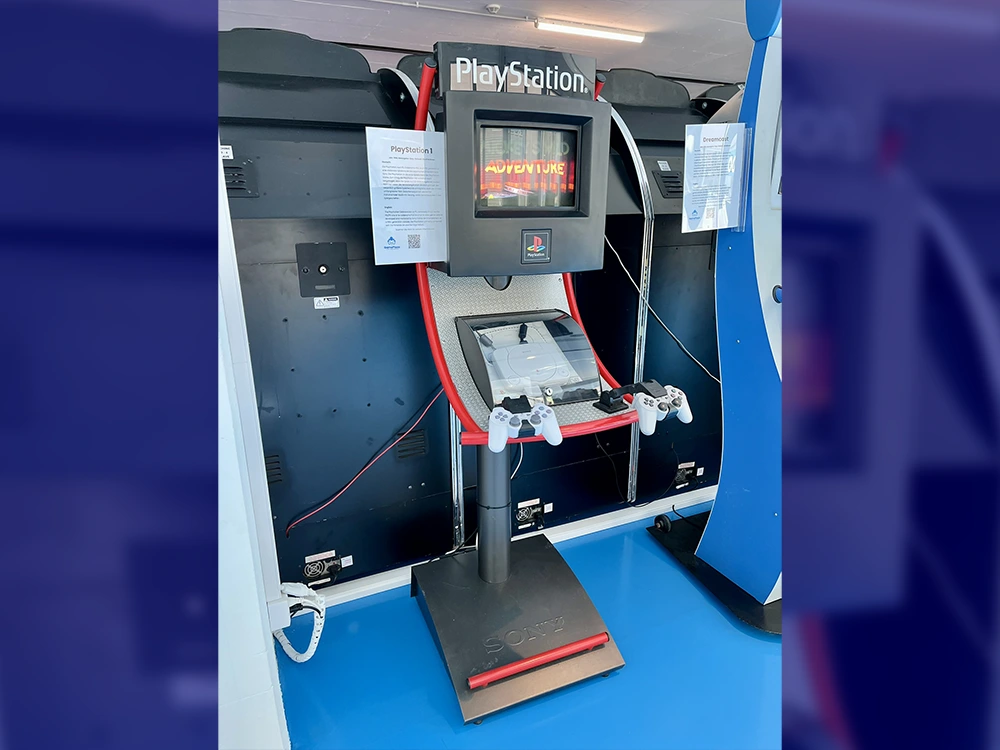
How to Choose and Change Games
The PlayStation 1 uses compact discs, so players choose a game by inserting the disc they want to play. Only one disc can be active at a time, and the inserted title is loaded directly by the console. This disc-based format allowed games to hold much more data than many cartridge-based competitors of the time.
To change games, the player opens the disc lid, removes the current disc, inserts another one, and waits for the system to load the new title. This process became standard for many later consoles and helped make optical media a normal part of home gaming.
- Choose a game by selecting its disc.
- Insert one disc at a time.
- Open the lid and remove the current disc before changing games.
- Let the system load the new title.
- Use a memory card to keep save data between sessions.
Game Library
The PlayStation 1 built one of the most influential software libraries in console history. Its catalog included platformers, racing games, fighting games, survival horror, role-playing games, sports titles, and cinematic action-adventure experiences. This wide variety helped the system appeal to an enormous global audience.
One of the biggest strengths of the PlayStation was its third-party support. Many publishers treated it as a major priority platform, which gave Sony a constant flow of important releases. Because of this, the PlayStation became the home of many of the most memorable games of the late 1990s.
- Known for one of the strongest libraries of the fifth generation.
- Included major titles across many genres.
- Benefited from very strong third-party support.
- Helped define the rise of 3D console gaming.
- Remains highly respected by collectors and retro players.
Most Popular Games
Several games became especially associated with the original PlayStation because they helped define both the console and the wider era in which it rose to prominence.
- Final Fantasy VII – One of the most famous role-playing games ever released and a major landmark for the platform.
- Metal Gear Solid – A highly influential action-adventure game strongly linked to the PlayStation identity.
- Gran Turismo – A major racing title that became one of Sony’s most important long-term franchises.
- Crash Bandicoot – One of the most recognizable mascot platform games of the PlayStation era.
- Resident Evil – A key title in the rise of survival horror on home consoles.
These games matter because they reflect the PlayStation’s main strengths: technical ambition, genre variety, strong third-party partnerships, and wide cultural appeal.
History
The original PlayStation was Sony’s first home console and entered the market during a time of major change in the game industry. It arrived in the mid-1990s and quickly established itself as a serious competitor in a field previously dominated by Nintendo and Sega.
Its success helped transform Sony from a newcomer into one of the most powerful companies in video game history. The PlayStation did not simply perform well as a product; it created an entire long-term hardware brand that would shape the industry for decades.
- Released as Sony’s first home video game console.
- Part of the fifth generation of gaming hardware.
- Helped Sony enter and reshape the console market.
- Became a major rival to Sega and Nintendo.
- Created the foundation for the long-running PlayStation brand.
Hardware
The PlayStation 1 was designed as a disc-based 32-bit home console with support for controllers, memory cards, and optical game media. Its use of CDs gave developers more storage space and made it easier to create larger, more cinematic, and more audio-rich experiences than many earlier cartridge systems allowed.
The console also became well known for its controller evolution, including the later introduction of the Dual Analog and DualShock designs. These controller developments became an important part of the broader PlayStation identity in later generations.
- Built as a 32-bit disc-based home console.
- Used compact discs for game software.
- Supported external memory cards for saves.
- Helped popularize disc-based home gaming.
- Introduced controller ideas that influenced later PlayStation systems.
Market Impact
The original PlayStation achieved enormous commercial success and became one of the best-selling consoles of its era. Lifetime hardware sales are widely reported at approximately 102 million units worldwide, making it the first home console to surpass the 100 million mark.
These sales figures are important because they show how dramatically Sony succeeded with its first console. The PlayStation built a massive installed base, supported a huge software market, and gave Sony a leading commercial position in the console industry.
- About 102 million units sold worldwide over its lifetime.
- Became the first console to sell more than 100 million units.
- Built a massive global installed base.
- Supported one of the largest software markets of its generation.
- Established Sony as a major long-term force in the console business.
Because of this, the PlayStation 1’s market impact is best understood through its landmark sales performance. Its commercial success made it one of the most important hardware launches in gaming history and laid the foundation for everything that followed in the PlayStation brand.
Fun Facts
The original PlayStation is especially memorable because it was the machine that began Sony’s rise in the video game industry. For many players, it represents the moment when gaming became more cinematic, more mainstream, and more strongly shaped by 3D design.
- It was Sony’s first home video game console.
- It became the first console to pass 100 million units sold.
- It helped make compact discs standard in console gaming.
- It introduced many players to landmark 3D games.
- It remains one of the most iconic consoles ever released.
The PlayStation 1 represents one of the most important turning points in video game history, combining major sales success, a massive software library, and lasting industry influence in one console. With its landmark commercial performance and foundational role in Sony’s gaming future, it remains one of the defining systems of all time. If you would like to explore that story more closely, visit Gameplaza in Altstetten, Zurich, where the PlayStation can be discovered as part of a wider journey through the past, present, and future of video games.
Important Info
| Codename: | PSX |
| Also known as: | PS, PS1, PS one (redesign) |
| Developer: | Sony Computer Entertainment |
| Manufacturer: | Sony Electronics |
| Product family: | PlayStation |
| Type: | Home video game console |
| Generation: | Fifth |
| Release date: | PlayStation JP: 3 December 1994 NA: 9 September 1995 EU: 29 September 1995 AU: 15 November 1995 ZA: November 1996 HK/SG/TH/MY: December 1996 TW: December 1997 PS one |
| Introductory price: | ¥39,800, US$299, £299, F1,490, DM599 |
| Discontinued: | WW: 23 March 2006 |
| Units sold: | 102.49 million |
| Media: | CD-ROM |
| CPU: | R3000 @ 33.8688 MHz |
| Memory: | 2 MB RAM, 1 MB VRAM |
| Storage: | Memory card |
| Sound: | 16-bit, 24 channel ADPCM |
| Controller input: | PlayStation controller, PlayStation Analog Joystick, Dual Analog Controller, DualShock |
| Connectivity: | PlayStation Link Cable |
| Online services: | i-mode Mobile Phone Connection Cable (Japan only) Lightspan Online Connection CD (third-party) |
| Best-selling game: | Gran Turismo (10.85 million) |
| Successor: | PlayStation 2 |