
Special Exhibition
Junk Yard Pinball
Year: 1996, Manufacturer: Williams Electronic, Genre: Pinball
Junk Yard Pinball is one of the most creative pinball machines of the 1990s. Released by Williams in December 1996, the game drops players into the scrapyard of the loud and unpredictable Crazy Bob, where the goal is to collect junk, build strange inventions, and eventually escape in spectacular fashion. Instead of using a traditional fantasy, sports, or sci-fi theme from the start, the table turns a messy junkyard into a playful story-driven adventure.
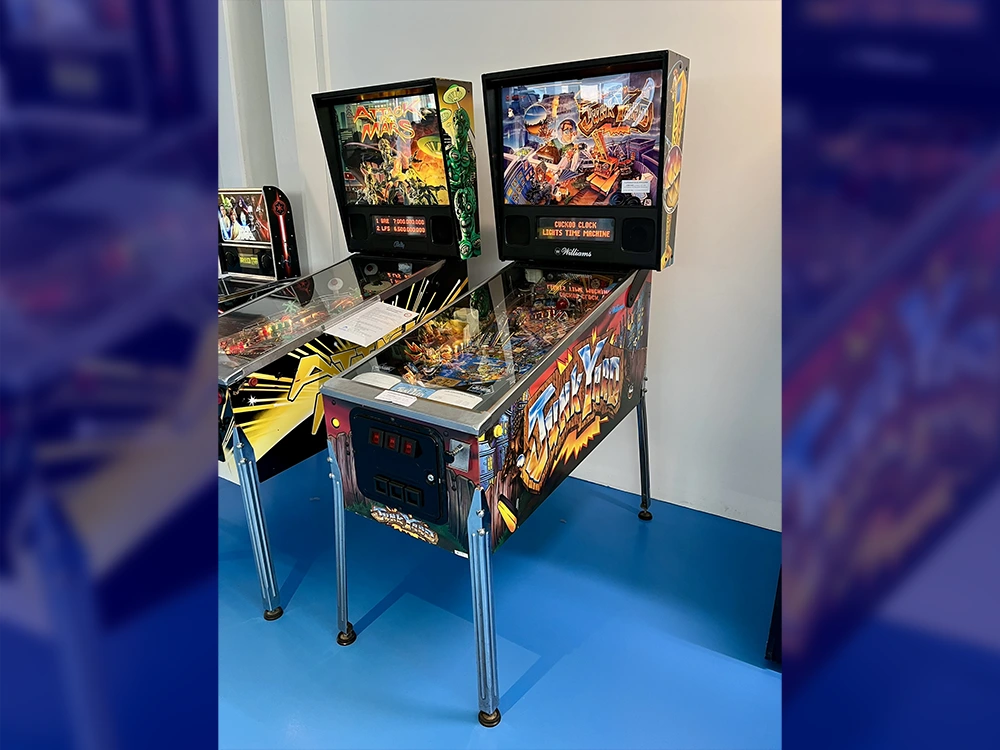
What makes Junk Yard special is how strongly its theme connects to the gameplay. The machine does not just look funny — it uses a wrecking ball hanging from a chain, a toilet that flushes the ball, a VW-style Magic Bus, and a doghouse with an attack dog to create shots and modes that feel tied to the junkyard setting. That strong integration is a big reason the machine is still remembered fondly by many players and collectors.
- Manufacturer: Williams Electronics Games, Incorporated.
- Release date: December 1996.
- Designers: Barry Oursler and Dwight Sullivan, with concept credit also including Adam Rhine.
- Platform: Williams WPC-95.
- Production total: 3,013 confirmed units.
- Famous toys: Crane with wrecking ball, toilet, Magic Bus, and doghouse with attack dog.
- Average fun rating on IPDB: 7.9/10 based on user ratings listed there.
For readers new to the game, the simplest way to understand Junk Yard is this: you are trapped in Crazy Bob’s yard, and every good shot helps you gather random scrap parts that eventually unlock bigger modes and a final showdown. That clear sense of progression makes the machine feel more like an adventure than a standard score-chasing table.
How to Play Junk Yard Pinball
At a basic level, Junk Yard is about collecting junk items and turning them into inventions. The lower middle playfield shows a blueprint with ten junk items, and the game begins with the toaster already awarded. As you collect more parts, you complete contraptions that light the game’s main adventures, and those adventures eventually lead to the final Outer Space mode.
This gives the machine a very satisfying structure. Instead of hitting shots at random, players are usually trying to move toward a specific short-term goal, like collecting one more junk item, starting a video mode, lighting multiball, or qualifying an adventure at the sewer. The result is a table that rewards both beginners and more strategic players.
- The game starts with the toaster already collected.
- There are 10 junk items in total, including the hair dryer, cuckoo clock, television, weathervane, fishbowl, propeller, fan, bathtub, and bicycle wheels.
- Collecting junk completes inventions.
- Completed inventions light adventures at the sewer.
- The first four adventures must be completed before the final Outer Space mode can be reached, along with collecting all junk.
Starting the game
A smart start matters in Junk Yard. The plunge lane includes a spinner-based skill shot, and the lit award changes as the spinner turns. The rulesheet notes that players can aim for awards such as Collect Junk, Bonus x2, and other skill-shot benefits, and that a controlled or weaker plunge can sometimes help land the preferred award.
Early in the game, Collect Junk is especially valuable because it speeds up your progress toward inventions and adventures. Since the machine is built around progression, getting junk early often matters more than chasing small points.
- Try to learn the skill shot timing.
- Prioritize Collect Junk when possible.
- Use early ball time to understand the table’s main shots: toilet, bus ramp, DOG scoop, sewer, and crane area.
Main shots and objectives
The game revolves around five major shot areas that keep coming back in different modes. These are the Great Toilet, Magic Bus, DOG scoop, Sewer, and Crane/center shot areas. As you play, these shots become important for junk collection, video modes, multiball setup, and adventure completion.
The sewer is especially important because it is used to start adventures and collect certain awards. The rulesheet even describes it as a shot worth practicing because so many major features depend on it.
- Toilet: Builds the toilet jackpot and can also award features like Choose Junk or Window Shopping when lit.
- Bus ramp: Can award Collect Junk or Magic Bus, which gives a random award sequence.
- DOG scoop: Spells D-O-G and can trigger video modes.
- Sewer: Starts adventures and collects important awards.
- Crane: Helps spell MULTIBALL and drives one of the machine’s most memorable mechanics.
Adventures and endgame
There are five adventures in Junk Yard: Radar Adventure, The Great Jalopy Race, The Great Toilet Adventure, Air Tactical Combat, and Outer Space. The first four are timed single-ball modes that become available when you have collected the right junk to build the corresponding invention, while Outer Space only lights after you complete the first four adventures and collect all the junk.
That final mode is one of the table’s biggest payoffs. According to the rulesheet, Outer Space is a four-ball multiball with continuous autofire, and the goal is to hit all five major lit shots before your fireworks run out. If you clear all five, you defeat Crazy Bob and complete the mode.
- Radar Adventure: Hit changing lit major shots to collect fireworks.
- Great Jalopy Race: Hit all five major shots within the time limit.
- Great Toilet Adventure: Score through toilet- and sewer-related shots while collecting fireworks.
- Air Tactical Combat: Hit the crane ball five times.
- Outer Space: A final multiball battle against Crazy Bob.
Beginner tips
For beginners, the best strategy is to focus on progress rather than panic shooting. Junk Yard has a funny theme, but it is actually a fairly structured game underneath, and understanding the shot order makes it much more enjoyable.
- Learn the sewer shot early.
- Use the skill shot to collect junk faster.
- Don’t ignore multiball, because the rulesheet says multiball is one of the game’s biggest scoring sources.
- Keep building toward adventures instead of only repeating the easiest shot.
- Watch for lit features at the toilet and bus ramp, since both can accelerate junk collection.
History of Junk Yard Pinball
Junk Yard arrived late in the Williams pinball era, a period known for bold themes, advanced rules, and inventive mechanical toys. It was released in December 1996 on the WPC-95 system, which places it among the later Williams solid-state machines before the company exited the pinball business a few years later.
The game was designed by Barry Oursler and Dwight Sullivan, with concept credit also including Adam Rhine. Its art was created by Paul Barker, Pat McMahon, and Linda Deal, while Kurt Goebel handled both music and sound. These credits matter because Junk Yard feels like a machine where design, audio, rules, and visuals were all pushing toward the same playful identity.
- Designed by Barry Oursler and Dwight Sullivan.
- Concept also credited to Adam Rhine.
- Software by Dwight Sullivan and Graham West.
- Music and sound by Kurt Goebel.
- Voice work included multiple voices by Tim Kitzrow.
Historically, the machine is interesting because it refused to follow a safer theme. Instead of choosing a movie license or a more traditional action concept, Williams built a game around scrap heaps, absurd inventions, and a junkyard escape story. That creative risk is a major part of why the machine still stands out today.
It also has a respectable production run of 3,013 confirmed units, which means it is not the rarest Williams table, but it is also not so common that every player has spent extensive time with it. That combination has helped preserve its reputation as a distinctive title with a loyal following.
Hardware and Playfield Features
A huge part of Junk Yard’s charm comes from its physical layout and toys. The IPDB lists the machine’s notable features as including two flippers, two slingshots, standup targets, drop targets, and most famously a ball hanging from a chain. On this table, that hanging ball is not just decorative — it is the heart of the crane mechanism and one of the first things players notice.
The rulesheet explains that the crane sits near the top center of the playfield and can be raised or lowered, allowing the hanging ball to block or reveal the center shot. Because the crane ball can be struck into surrounding car targets, it creates unusual movement and gives the table a mechanical personality that few machines can match.
- Wrecking-ball crane at the top center of the playfield.
- Toilet ramp that spins and flushes the ball.
- Magic Bus toy linked to random awards.
- DOG scoop and doghouse for video mode interactions.
- Sewer sinkhole used for major progression.
- Manual plunger with autoplunger function through a spinner lane.
Crane wrecking ball
The crane is the machine’s signature toy. In regular play, hitting the crane ball into the car targets helps spell MULTIBALL, and once multiball is lit, the crane position changes to open the center shot for jackpots and super jackpots. That means the crane is both a visual showpiece and a major scoring tool.
Great Toilet
The toilet is one of the funniest features in pinball. According to the rulesheet, each spin the ball takes in the toilet adds 1,000 points to the toilet jackpot, which carries through the game, and the shot can also be lit for special functions like Window Shopping or Choose Junk. That makes it much more than a joke feature.
Magic Bus and DOG scoop
The Magic Bus awards random prizes when lit, while the DOG scoop leads into video modes tied to Spike the junkyard dog. If the toaster gun has not been completed, players get Run from Spike; if it has, they can play Save the Girl, where toast is fired using the flipper buttons. These features add humor, variety, and a strong sense of character.
Fun Facts About Junk Yard Pinball
Junk Yard is full of details that make it easy to remember. Even players who do not know the deeper rules often remember “the pinball machine with the toilet and wrecking ball,” which says a lot about how effective its toy design is. The machine also hides a lot of personality in its rules and presentation. The rulesheet describes an angel-and-devil guidance system on the display, references to earlier Williams games through the Time Machine feature, and even a Midnight Madness mode if the machine clock is set correctly and a game is in progress at midnight.
- The machine was marketed with slogans including “The meanest game in the whole darn town” and “It’s not hard to play in the yard.”
- Prototype machines reportedly had a magnet below the wrecking ball, but production machines did not keep that feature.
- Tim Kitzrow provided multiple voices for the game.
- The Time Machine mode references older Williams titles.
- There is a secret mania tied to the Time Machine clock showing 3:33, according to the rulesheet.
- The machine includes a Junk Champion feature for collecting all junk.
These little details help explain why Junk Yard has remained appealing for so long. It is not just mechanically unusual; it is packed with humor, secret touches, and a clear point of view. That combination makes it feel like a machine with real personality rather than just a list of shots and modes.
Important Info
| Manufacturer: | Williams |
| Release date: | December 1996 |
| System: | Williams WPC-95 |
| Design: | Barry Oursler, Dwight Sullivan |
| Programming: | Dwight Sullivan, Graham West |
| Artwork: | Paul Barker, Pat McMahon, Linda Deal (aka Doane) |
| Voices: | Tim Kitzrow |
| Production run: | 3,013 |